Which of the Following Family Problems Contribute to Lower Achievement Among Low-income Students
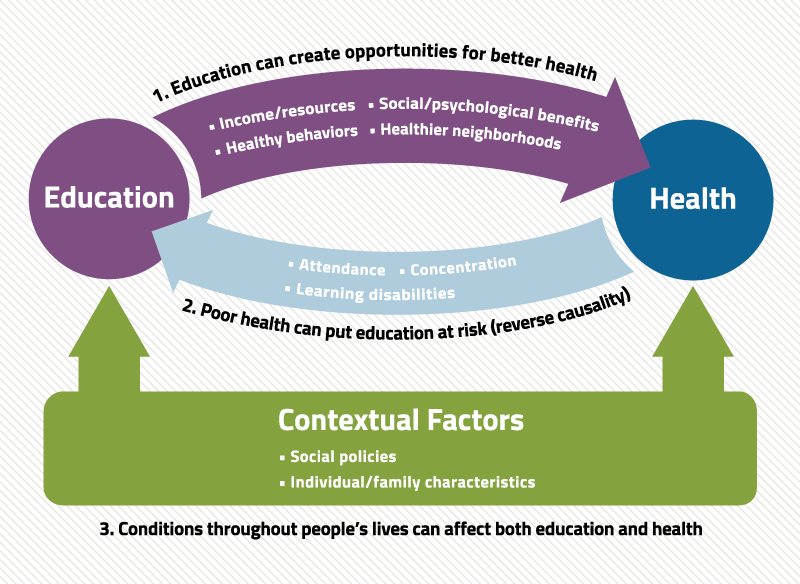
Americans with more than education live longer, healthier lives than those with fewer years of schooling (encounter Issue Brief #1). But why does education matter so much to wellness? The links are complex—and tied closely to income and to the skills and opportunities that people have to pb good for you lives in their communities.
How are health and education linked? There are three main connections:1
- Instruction can create opportunities for better health
- Poor health can put educational attainment at risk (opposite causality)
- Atmospheric condition throughout people'due south lives—beginning in early childhood—tin bear on both wellness and didactics
Read More
This effect cursory, created with support from the Robert Wood Johnson Foundation, provides an overview of what research shows about the links between education and health alongside the perspectives of residents of a disadvantaged urban community in Richmond, Virginia. These community researchers, members of our partnership, collaborate regularly with the Centre on Society and Health'southward research and policy activities to help u.s.a. more fully understand the "real life" connections betwixt community life and health outcomes.
1. The Health Benefits of Education
Income and Resources

"Existence educated now means getting better employment, teaching our kids to exist successful and just making a difference in, just in everyday life." —Brenda
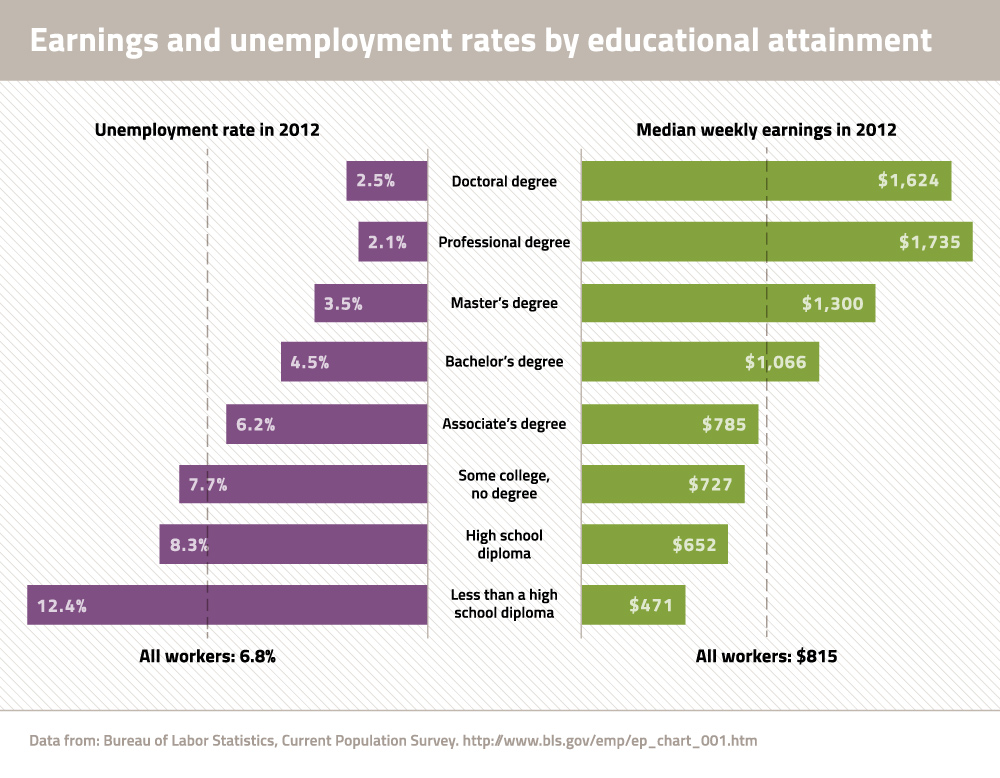
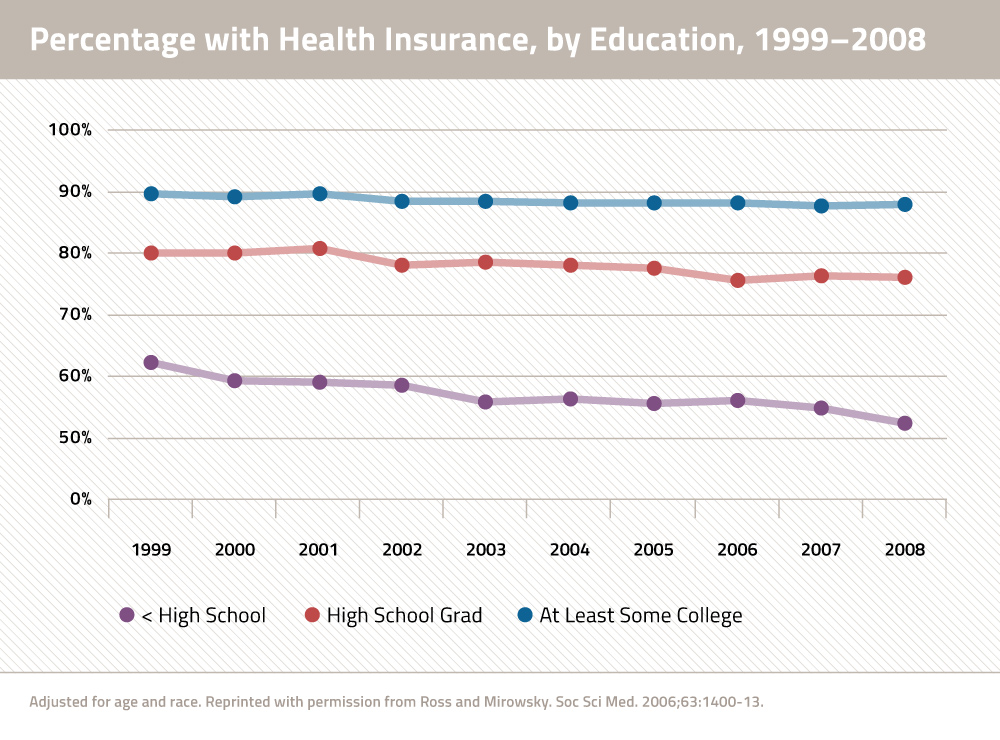
Better jobs: In today'south knowledge economy, an bidder with more education is more than likely to be employed and country a job that provides health-promoting benefits such every bit health insurance, paid leave, and retirement.5 Conversely, people with less education are more probable to piece of work in high-risk occupations with few benefits.
College earnings: Income has a major effect on wellness and workers with more education tend to earn more money.2 In 2012, the median wage for higher graduates was more than than twice that of high school dropouts and more than i and a half times higher than that of high school graduates.6 Read More than

"Definitely having a good education and a good paying chore tin relieve a lot of mental stress."
—Chimere
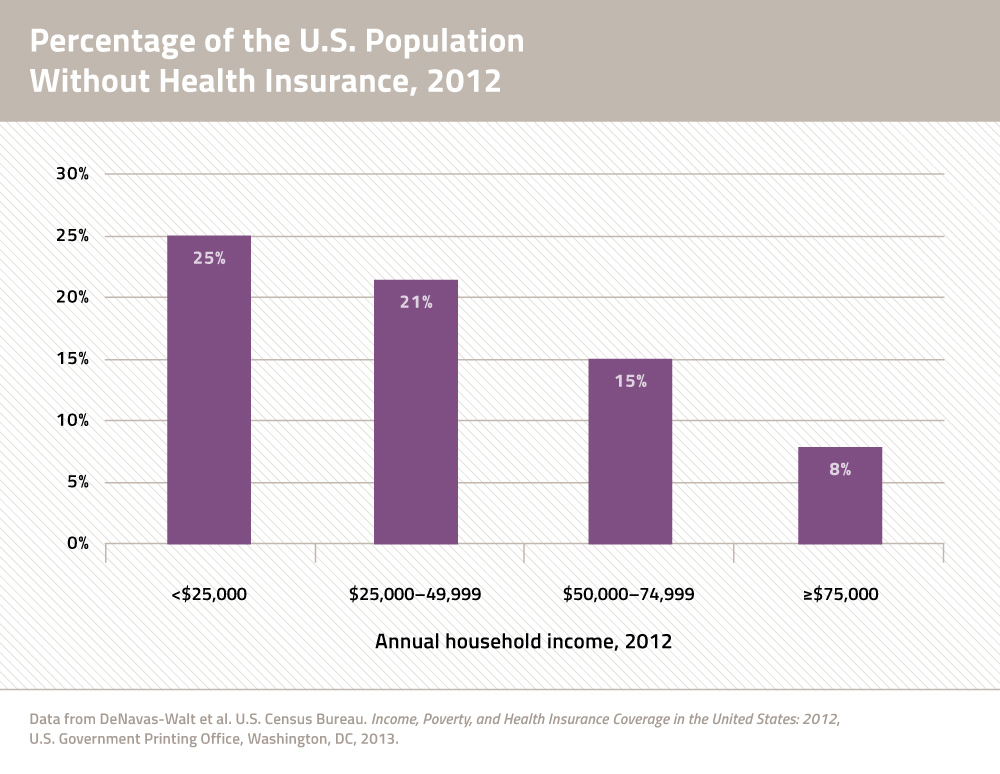
Resources for good wellness: Families with higher incomes can more hands purchase good for you foods, have fourth dimension to exercise regularly, and pay for health services and transportation. Conversely, the task insecurity, low wages, and lack of avails associated with less education can make individuals and families more vulnerable during hard times—which can lead to poor nutrition, unstable housing, and unmet medical needs. Read More

Social and Psychological Benefits

"So through school, we larn how to socially engage with other classmates. We learn how to engage with our teachers. How we speak to others and how we allow that to grow as we get older allows united states of america to acquire how to ask those questions when we're working within the healthcare system, when we're working with our doctor to understand what is going on with usa."
—Chanel
Reduced stress: People with more pedagogy—and thus higher incomes—are often spared the health-harming stresses that accompany prolonged social and economic hardship. Those with less education often take fewer resources (e.g., social support, sense of control over life, and loftier self-esteem) to buffer the effects of stress. Read More
Social and psychological skills: Education in school and other learning opportunities outside the classroom build skills and foster traits that are important throughout life and may be important to health, such as conscientiousness, perseverance, a sense of personal control, flexibility, the capacity for negotiation, and the ability to form relationships and establish social networks. These skills tin help with a variety of life's challenges—from work to family life—and with managing i'due south health and navigating the health intendance system. Read More
Social networks: Educated adults tend to have larger social networks—and these connections bring access to financial, psychological, and emotional resources that may assistance reduce hardship and stress and meliorate health. Read More
"Being able to advocate and inquire for what yous want, helps to facilitate a healthier lifestyle. … If information technology'southward needing your customs to have dark-green spaces, have a park, a playground, accept amend trails inside the customs, advocating for that volition help."
—Chanel
Health Behaviors
Cognition and skills: In add-on to being prepared for better jobs, people with more than education are more likely to learn about healthy behaviors. Educated patients may be more than able to empathize their health needs, follow instructions, advocate for themselves and their families, and communicate effectively with health providers.21 Read More
Healthier Neighborhoods

"Poor neighborhoods frequently lead to poor schools. Poor schools lead to poor education. Poor teaching ofttimes leads to poor work. Poor work puts you right dorsum into the poor neighborhood. Information technology'south a savage wheel that happens in communities, peculiarly inner cities." —Albert
Lower income and fewer resources mean that people with less instruction are more than likely to live in low-income neighborhoods that lack the resource for good health. These neighborhoods are often economically marginalized and segregated and have more chance factors for poor health such every bit:
- Less access to supermarkets or other sources of good for you food and an oversupply of fast food restaurants and outlets that promote unhealthy foods.25
Read More

"If the all-time thing that y'all meet in the neighborhood is a drug dealer, then that becomes your goal. If the best affair you see in your neighborhood is working a ix to 5, then that becomes your goal. But if you see the doctors and the lawyers, if you see the teachers and the professors, then that becomes your goal." —Marco

"It'south a lot of things going on [in this customs], a lot of challenges. It's only difficult sometimes to try and go people to come together, as one, just and then we can solve the problem." —Toni
- Less green infinite, such as sidewalks and parks to encourage outdoor physical activity and walking or cycling to piece of work or school.
- Rural and low-income areas, which are more populated by people with less education, often suffer from shortages of master care physicians and other health care providers and facilities.
- Higher law-breaking rates, exposing residents to greater risk of trauma and deaths from violence and the stress of living in unsafe neighborhoods. People with less instruction, particularly males, are more probable to be incarcerated, which carries its own public health risks.
- Fewer high-quality schools, ofttimes considering public schools are poorly resourced past low property taxes. Low-resourced schools take greater difficulty offering attractive teacher salaries or properly maintaining buildings and supplies.
- Fewer jobs, which can exacerbate the economical hardship and poor health that is common for people with less education.
- Higher levels of toxins, such equally air and water pollution, hazardous waste, pesticides, andindustrial chemicals.27
- Less effective political influence to abet for community needs, resulting in a persistent cycle of disadvantage.
2. Poor Health That Affects Educational activity (Contrary Causality)
"Things that happen in the home can definitely touch on a child being able to even concentrate in the classroom. … If y'all're hungry, yous can't learn with your belly growling. … If you're worried about your mom beingness safe while yous're at school, you're not going to be able to pay attention." —Chimere
The relationship between pedagogy and health is never a simple ane. Poor wellness not only results from lower educational attainment, it can likewise cause educational setbacks and interfere with schooling.
For example, children with asthma and other chronic illnesses may feel recurrent absences and difficulty concentrating in grade.28 Disabilities can as well affect school performance due to difficulties with vision, hearing, attention, beliefs, absenteeism, or cognitive skills. Read More
iii. Atmospheric condition Throughout the Life Course—Beginning in Early on Childhood—That Bear on Both Health and Education
A third way that education tin exist linked to wellness is past exposure to weather condition, first in early babyhood, which tin bear on both education and health. Throughout life, conditions at home, socioeconomic status, and other contextual factors tin can create stress, crusade disease, and deprive individuals and families of resources for success in schoolhouse, the workplace, and healthy living. Read More
What well-nigh social policy?
Social policy—decisions near jobs, the economic system, pedagogy reform, etc.—is an important driver of educational outcomes AND affects all of the factors described in this brief. For case, underperforming schools and bigotry bear upon non only educational outcomes but also economical success, the social environment, personal behaviors, and access to quality health intendance. Social policy affects the teaching system itself only, in addition, individuals with low educational attainment and fewer resource are more than vulnerable to social policy decisions that bear upon access to health care, eligibility for aid, and support services.
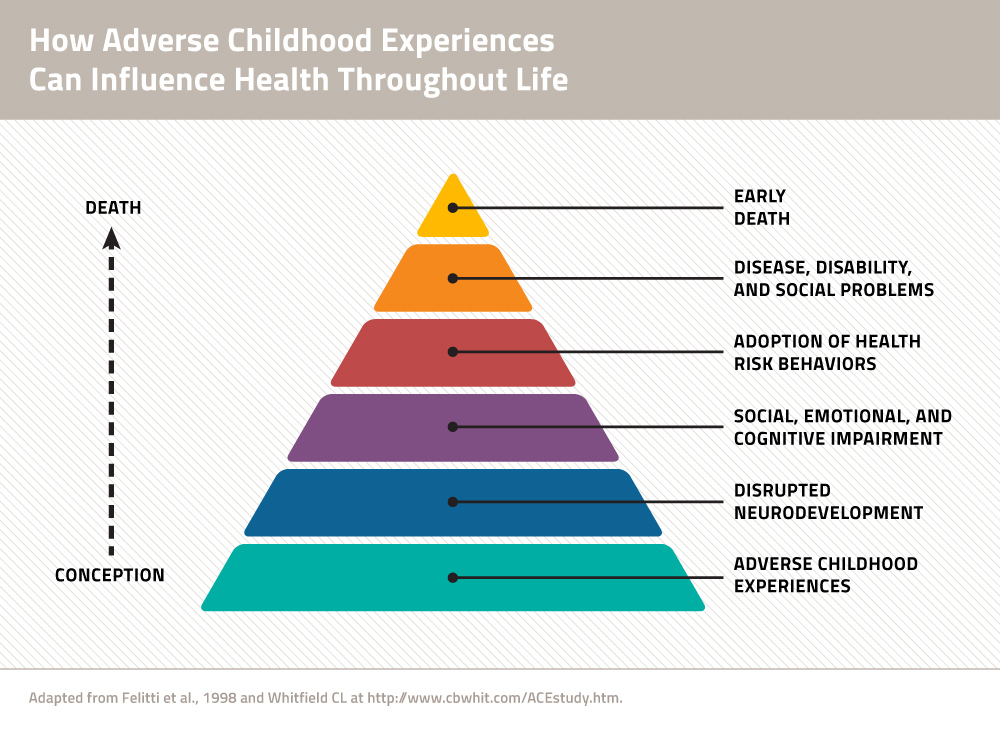
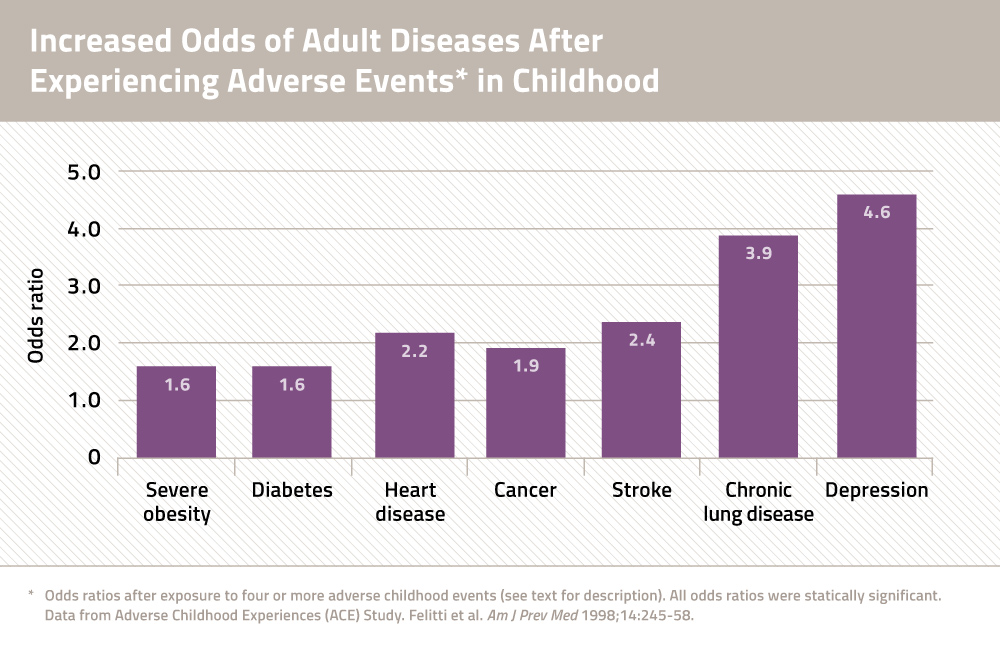
A growing trunk of research suggests that chronic exposure of infants and toddlers to stressors—what experts call "agin childhood experiences"—can affect brain development and disturb the child's endocrine and immune systems, causing biological changes that increase the chance of heart disease and other conditions later in life (encounter Graphic i). For example:
"The connection that I will say between pedagogy and wellness would exist a healthy mind produces a salubrious person. A motivated mind produces a motivated person. A curious mind produces a curious person. When you have those things it drives you to want to know more, to desire to have more, to desire to inquire more. And when you desire more, you will get more. You know where the mind goes the person follows… and that includes health." —Marco
- The adverse effects of stress on the developing brain and on behavior can affect performance in schoolhouse and explain setbacks in didactics. Thus, the correlation between lower educational attainment and illness that is subsequently observed amidst adults may have as much to do with the seeds of illnessand inability that are planted before children e'er accomplish school age as witheducation itself.
- Children exposed to stress may also exist drawn to unhealthy behaviors—such equally smoking or unhealthy eating—during adolescence, the historic period when developed habits are often outset established.
Read More
What about private characteristics?
Characteristics of individuals and families are important in the relationship betwixt education and health. Race, gender, age, disability and other personal characteristics often affect educational opportunities and success in school (see Issue Brief #1). Bigotry and racism have multiple links to education and health. Racial segregation reduces educational and job opportunities51 and is associated with worse wellness outcomes.52, 53
How does education bear upon wellness in your community?
The Center on Society and Wellness (CSH) worked with members of Engaging Richmond, a customs-academic partnership that included residents of the East End, a disadvantaged neighborhood of Richmond, Virginia. This research into the links betwixt education and health was a airplane pilot report to learn how individuals could add to our understanding of this complex event using the lens of their own experiences.
What does your community accept to say almost the links between instruction and health – or other health disparities? Learn more near community enquiry partnerships and community engagement:
- Principles of Community Engagement, 2nd Edition
- Customs Campus Partnerships for Health
- Customs Engaged Scholarship Toolkit
- AHRQ — The Role of Community-Based Participatory Research
- CSH's Community University Partnership
References
- Cutler D., and Lleras-Muney A. Education and Health. In: Anthony J. Culyer (ed.), Encyclopedia of Wellness Economics, Vol i. San Diego: Elsevier; 2014. pp. 232-45.
- Olshansky SJ, et al. Differences in life expectancy due to race and educational differences are widening, and many may non catch upwardly. Health Aff 2012;31:1803-13.
- Goldman D, Smith JP. The increasing value of education to health. Soc Sci Med 2011;72:1728-37.
- Montez JK, Berkman LF. Trends in the educational gradient of mortality amidst Us adults aged 45 to 84 years: bringing regional context into the explanation. Am J Public Health 2014;104:e82-90.
- Baum S, Ma J, Payea K. Education Pays 2013: The Benefits of Higher Educational activity for Individuals and Society. College Board, 2013.
- Electric current Population Survey, U.S. Section of Labor, U.S. Bureau of Labor Statistics. Accessed iv/9/xiv at http://world wide web.bls.gov/emp/ep_table_001.htm.
- Julian TA and Kominski RA. Education and Synthetic Piece of work- Life Earnings Estimates. American Customs Survey Reports, ACS-fourteen. Washington, DC: U.S. Census Bureau, 2011.
- Sobolewski JM, Amato PR. Economical hardship in the family of origin and children'due south psychological well-being in machismo. J Marriage Fam 2005;67:141-56.
- Centers for Disease Control, Office of Surveillance, Epidemiology, and Laboratory Services. Behavioral Hazard Factor Surveillance Arrangement, 2010 BRFSS Information. Accessed Feb xiv, 2014 at http://www.cdc.gov/brfss/data_tools.htm
- Steele CB, et al. Colorectal Cancer Incidence and Screening – United States, 2008 and 2010. CDC Wellness Disparities and Inequalities Written report — United States, 2013. Centers for Affliction Control. MMWR 2013;62(3):53-threescore.
- Mcewen BS, Stellar East. Stress and the individual: mechanisms leading to illness. Arch Int Med 1993;153:2093-101.
- Karlamangla AS, et al. Reduction in allostatic load in older adults is associated with lower all-cause mortality take a chance. Psychosom Med 2006;68:500–7.
- Ross CE, Wu CL. The links betwixt educational activity and health. Am Soc Rev 1995;60:719-45.
- Roberts BW, et al. The ability of personality: The comparative validity of personality traits, socioeconomic condition, and cognitive ability for predicting of import life outcomes. Perspect Psychol Sci 2007;2:313-45.
- Heckman JJ, Kautz T. Hard testify on soft skills. Labour Economics 2012;nineteen:451-64.
- Berkman LF. The role of social relations in health promotion. Psychosom Med 1995;57:245-54.
- Ross CE, Mirowsky J. Refining the association between instruction and wellness: the furnishings of quantity, credential, and selectivity. Demography 1999;36:445-sixty.
- Kaplan GA, et al. Social functioning and overall mortality: Prospective prove from the Kuopio Ischemic Heart Illness Gamble Factor Study. Epidemiology 1994;v:495-500.
- Seeman TE. Social ties and health: the benefits of social integration. AEP 1996;6:442-51.
- Sum A, et al. The Consequences of Dropping Out of High School: Joblessness and Jailing for Loftier School Dropouts and the High Cost for Taxpayers. Centre for Labor Market Studies, Northeastern University, Boston, 2009.
- Goldman DP, Smith JP. Can patient cocky-management help explain the SES health slope? Proc Natl Acad Sci 2002;10929–10934.
- Spandorfer JM, et al. Comprehension of belch instructions past patients in an urban emergency department. Ann Emerg Med 1995;25:71-4.
- Williams MV, et al. Inadequate literacy is a barrier to asthma knowledge and cocky-intendance. Chest 1998;114:1008-15.
- Berkman ND, et al. Low health literacy and wellness outcomes: an updated systematic review. Ann Intern Med 2011;155:97-107.
- Ver Ploeg Yard, et al. Access to Affordable and Nutritious Food—Measuring and Understanding Nutrient Deserts and Their Consequences: Report to Congress. Washington, DC: U.South. Department of Agriculture, 2009.
- Grimm KA, et al. Admission to Health Nutrient Retailers—Unites States, 2011. CDC Wellness Disparities and Inequalities Report — United states, 2013. Centers for Affliction Command. MMWR Morb Mortal Wkly Rep 2013;62: twenty-26.
- Brulle RJ, Pellow DN. Environmental justice: human being health and environmental inequalities. Annu Rev Public Health 2006;27:103-24.
- Basch CE. Healthier Students Are Meliorate Learners: A Missing Link in School Reforms to Shut the Accomplishment Gap. New York: Columbia University, 2010.
- Case A, et al. The lasting affect of childhood wellness and circumstance. J Health Econ 2005;24:365-89.
- Suhrcke Thou, de Paz Nieves C. The impact of health and wellness behaviours on educational outcomes in loftier-income countries: a review of the evidence. Copenhagen, WHO Regional Office for Europe, 2011.
- Barbaresi WJ, et al. Long-term school outcomes for children with attention-arrears/hyperactivity disorder: a population-based perspective. J Dev Behav Pediatr 2007;28:265-73.
- Behrman JR, Rosenzweig MR. 2004. Returns to birthweight. Rev Econ Statistics 2004;86:586-601.
- Black SE. et al. From the Cradle to the Labor Market place? The Effect of Nativity Weight on Adult Outcomes. NBER Working Papers 11796, National Bureau of Economical Research, 2005.
- Avchen RN, et al. Birth weight and schoolhouse-age disabilities: a population-based study. Am J Epidemiol 2002;154:895-901.
- Chapman DA, et al. Public health arroyo to the report of mental retardation. Am J Ment Retard 2008;113:102-16.
- Conti G, Heckman JJ. Understanding the early on origins of the education-health gradient. Perspect Psychol Sci 2010;5:585-605.
- Denhem SA. Social-emotional competence equally support for school readiness: what is information technology and how practice we assess It? Early Educ Dev 2006;17:57-89.
- Williams Shanks TR, Robinson C. Assets, economic opportunity and toxic stress: a framework for understanding kid and educational outcomes. Econ Educ Rev 2013;33:154-70.
- Currie J. Salubrious, wealthy, and wise: socioeconomic status, poor wellness in childhood, and human capital development. J Econ Lit 2009,47:87–122.
- Leventhal T, Brooks-Gunn J. The neighborhood they live in: the furnishings of neighborhood residence on child and adolescent outcomes. Psychol Balderdash 2000;126:309-337.
- Barnett WS, Belfield CR. Early babyhood development and social mobility. Future Kid 2006;16:73-98.
- Hackman DA, et al. Socioeconomic status and the brain: mechanistic insights from human and animal inquiry. Nat Rev Neurosci 2010;eleven:651-9.
- Gottesman II, Hanson DR. Human development: biological and genetic processes. Annu Rev Psychol 2005;56:263-86.
- Shonkoff JP, Phillips DA, Eds. From Neurons to Neighborhoods: The Science of Early Child Evolution. National Research Council and Institute of Medicine. Washington, DC: The National Academies Printing, 2000.
- Felitti VJ, et al. Human relationship of childhood abuse and household dysfunction to many of the leading causes of death in adults. The Adverse Childhood Experiences (ACE) Study. Am J Prev Med 1998;fourteen:245-58.
- McEwen BS. Brain on stress: how the social environment gets under the skin. Proc Natl Acad Sci 2012;109 Suppl two:17180-5
- Zhang TY, Meaney MJ. Epigenetics and the environmental regulation of the genome and its office. Annu Rev Psychol 2010;61:439-66.
- Egerter S, et al. Pedagogy and Health. Robert Woods Johnson Foundation, 2011.
- Mistry KB, et al. A new framework for childhood wellness promotion: the part of policies and programs in edifice chapters and foundations of early babyhood wellness. Am J Public Health 2012;102:1688-96.
- Liu Y, et al. Relationship between adverse childhood experiences and unemployment amid adults from five U.Southward. states. Soc Psychiatry Psychiatr Epidemiol 2013;48:357-69.
- Williams DR, Mohammed SA. Discrimination and racial disparities in health: Bear witness and needed research. J Behav Med 2009;32(i), twenty–47.
- White One thousand, Borrell LN. Racial/ethnic residential segregation: Framing the context of health risk and health disparities. Health Place 2011;xviii: 438-48.
- Smedley BD et al., eds. Unequal Handling: Confronting Racial and Ethnic Disparities in Health Care. Washington, DC: The National Academies Printing, 2003.
Source: https://societyhealth.vcu.edu/work/the-projects/why-education-matters-to-health-exploring-the-causes.html
0 Response to "Which of the Following Family Problems Contribute to Lower Achievement Among Low-income Students"
Post a Comment